Her Life
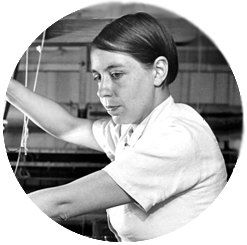
Born in Munich, Stölzl joined the Bauhaus in Weimar in its early years and trained in weaving. In 1925 she was appointed to lead the weaving workshop at Dessau, and in 1927 she became its head, the only woman to reach master-level responsibility at the school. She married Arieh Sharon, an architect, and later moved to Switzerland, where she founded her own handweaving company.
Her Work
She pushed the workshop from pictorial tapestries toward rigorous geometric design and technical experiment, working with new materials and with industry. Under her direction, textile prototypes were developed for mass production and sold. Notable pieces include Slit Tapestry Red/Green (1927-28) and Five Choirs (1928).
Why she was overlooked
Textiles were ranked below painting and architecture, so even the school's most successful workshop was treated as a side note. In 1931 she left the Bauhaus after harassment from students with Nazi sympathies, partly connected to her husband's Jewish background.
Her Legacy Today
Today she is recognised as one of the key figures of 20th-century textile design.
- Slit Tapestry Red/Green (1927–28)
- Five Choirs (1928)